I Can't Believe Santa Clause!
by one of my Korean middle-school students, a.k.a the author of such works as "Study Bug and Delinquency Man."
Santa Clause! He is little ones's favorite man. because he gives presents to little ones in Christmas, most of chidren like him. To be sure, I had liked him, too. However, [hate him] don't like that benign, old man no more. Why? It has a clear reason.
When I was a little girl; little, innocent, and pure girl, I went to preschool. Up to that time, I believed existence of Santa Clause. At Christmas, Santa Clause visited my preschool for giving presents. I writed a letter for Santa Clause. After I took the present, I was too delightful so I forgot delivering my letter [with my true heart] to Santa Clause. [Unavoidable] I returned to preschool and then searched Santa Clause. That moment, unfortunately I looked Santa's real things! Santa was smoking. And he was calling to his friend. He said abusive languages [Don't listen to this words] (pure child must not listen to this words!) Added to this, he took off his a spurious beard.
I shocked at his speach and behavior. I became stiffened. After Santa's telephone conversation, he look me in the eye and he open his face, "Damn it! Why are you looking me?"
I dissolved in tears. then runaway from his field of vision. I was muttering and muttering, "I hate Santa! I don't believe him anymore..."
This event is my awful memory about false Santa Clause. Whether or no he is false, I was astonished at that time. Give me back the innocence of a child! [I'm so sorry, I'm too late]
Wednesday, April 2, 2008

보 신 탕

Today, after Brian and I arrived at work, but before we had gone out to eat lunch (the order is a little different here and it is perfectly expected that we will take care of some personal business like meals on company time) Teacher Justin forbade me from making my usual trip to the local Pizza Hut that happens to be on our hakwon's street, saying that he wanted to do something special.
I was vaguely aware that Koreans where rumored to eat dog meat before I came here and I decided around that time that if the opportunity arose, I should give the stuff a try. "When in Rome..." has become a kind of mantra since I've been here. At different times, I've talked to the kids about whether or not they have ever tried 보 신 탕 (Bo Shen Tang, a.k.a. "Protect-Body Tonic"...a.k.a.--Dog Meat Soup!) Some say that they have, some say that they haven't. Some say they liked it, others say it was gross. Quite a few, mostly the girls, say that it sounds too gross to try. Demographically speaking, older Korean men seem to enjoy the stuff the most. As with all things offputting to a Westerner, the excuse for eating it is that it is good for your health, stamina, and is a "wellbeing" food.

Anyways, Bo Shen Tang is precisely what our Korean coworker Justin was suggesting that we eat today! I had expressed an interest in it a few weeks ago, and so he did some quick research on it on the internet today, found a restaurant with a good reputation within walking distance, and after taking care of a few office-related things, we grabbed another Korean, Teacher Liz, and set out! Morale was high at this point.

Sadly, Brian's morale would be
considerably lower by the time
the meal was finished...ㅠ.ㅠ
There has been some controversy over eating dogs, aside from the obvious Western objections, because apparently the method of killing the animals isn't (or used to not be) very humane. The dogs are apparently flogged to death with some sort of stick or pole because the Koreans believe that it not only softens the muscles, but also releases adrenaline and related fear-chemicals into the dog's body, which only makes the meat that much more healthy when you eat it...! Although I've heard from one source that this practice is no longer in use, I haven't heard that verified anywhere else, so I had to do some rationalizing to overrule any moral objections I had left. All animals bred to be slaughtered for human consumption are treated terribly. Chickens have their beaks melted so that they aren't pointy and they can't peck at each other; cows are moved through execution plants that have more in common with Auschwitz than most people would care to admit; and dogs are (maybe still) beaten to death fully conscious. Rationalization complete, I was ready to eat!
I had wanted to order just dog-meat steak to eat with vegetables, but the cost was prohibitive. It was a difference between 20,000won and 8,000. At the restaurant, they brought out rice and side dishes first, but moments later, the still bubbling bowls of soup arrived. Excited and conflicted, Brian, Justin, Liz and I posed for several photos before digging in:

Liz has eaten Bo Shen Tang
once before with her father.
Justin had a dog when he was
a kid once for three days before
his family killed and ate it. He
continues to eat, and thoroughly
enjoy, dog meat to this day!


You ready?

Hmm...

Mmh?

MMM!!!!

Slightly disturbing was that
some pieces of meat had large
clumps of fat and pieces of dog
skin were also cooked in the soup.
Admittedly, I ate around all that,
but I ate all of the pieces of meat
that I could find.
In conclusion, the meal was pretty good; the meat was tender, it had a slightly sweet taste from a minty type of leaf that it was cooked with and I probably liked it better than some Korean seafood dishes I've had over here. I wouldn't be opposed to eating it again. Someday, I may still fork over the money and try dog meat steak. Brian tried several bites of it and drank a little bit of the broth, but ultimately he couldn't get past the fact that he was eating a dog. Liz, Justin, and I shared the remainder of his soup. On the way back to the hakwon, Liz asked us not to mention to the kids that she had eaten Bo Shen Tang. She also doesn't want them to know that she's a smoker because some things just aren't considered appropriate for a polite woman over here, so we didn't; but you can bet Brian and I were bragging to the kids plenty today!
I was vaguely aware that Koreans where rumored to eat dog meat before I came here and I decided around that time that if the opportunity arose, I should give the stuff a try. "When in Rome..." has become a kind of mantra since I've been here. At different times, I've talked to the kids about whether or not they have ever tried 보 신 탕 (Bo Shen Tang, a.k.a. "Protect-Body Tonic"...a.k.a.--Dog Meat Soup!) Some say that they have, some say that they haven't. Some say they liked it, others say it was gross. Quite a few, mostly the girls, say that it sounds too gross to try. Demographically speaking, older Korean men seem to enjoy the stuff the most. As with all things offputting to a Westerner, the excuse for eating it is that it is good for your health, stamina, and is a "wellbeing" food.

Anyways, Bo Shen Tang is precisely what our Korean coworker Justin was suggesting that we eat today! I had expressed an interest in it a few weeks ago, and so he did some quick research on it on the internet today, found a restaurant with a good reputation within walking distance, and after taking care of a few office-related things, we grabbed another Korean, Teacher Liz, and set out! Morale was high at this point.

Sadly, Brian's morale would be
considerably lower by the time
the meal was finished...ㅠ.ㅠ
There has been some controversy over eating dogs, aside from the obvious Western objections, because apparently the method of killing the animals isn't (or used to not be) very humane. The dogs are apparently flogged to death with some sort of stick or pole because the Koreans believe that it not only softens the muscles, but also releases adrenaline and related fear-chemicals into the dog's body, which only makes the meat that much more healthy when you eat it...! Although I've heard from one source that this practice is no longer in use, I haven't heard that verified anywhere else, so I had to do some rationalizing to overrule any moral objections I had left. All animals bred to be slaughtered for human consumption are treated terribly. Chickens have their beaks melted so that they aren't pointy and they can't peck at each other; cows are moved through execution plants that have more in common with Auschwitz than most people would care to admit; and dogs are (maybe still) beaten to death fully conscious. Rationalization complete, I was ready to eat!
I had wanted to order just dog-meat steak to eat with vegetables, but the cost was prohibitive. It was a difference between 20,000won and 8,000. At the restaurant, they brought out rice and side dishes first, but moments later, the still bubbling bowls of soup arrived. Excited and conflicted, Brian, Justin, Liz and I posed for several photos before digging in:

Liz has eaten Bo Shen Tang
once before with her father.
Justin had a dog when he was
a kid once for three days before
his family killed and ate it. He
continues to eat, and thoroughly
enjoy, dog meat to this day!


You ready?

Hmm...

Mmh?

MMM!!!!

Slightly disturbing was that
some pieces of meat had large
clumps of fat and pieces of dog
skin were also cooked in the soup.
Admittedly, I ate around all that,
but I ate all of the pieces of meat
that I could find.
In conclusion, the meal was pretty good; the meat was tender, it had a slightly sweet taste from a minty type of leaf that it was cooked with and I probably liked it better than some Korean seafood dishes I've had over here. I wouldn't be opposed to eating it again. Someday, I may still fork over the money and try dog meat steak. Brian tried several bites of it and drank a little bit of the broth, but ultimately he couldn't get past the fact that he was eating a dog. Liz, Justin, and I shared the remainder of his soup. On the way back to the hakwon, Liz asked us not to mention to the kids that she had eaten Bo Shen Tang. She also doesn't want them to know that she's a smoker because some things just aren't considered appropriate for a polite woman over here, so we didn't; but you can bet Brian and I were bragging to the kids plenty today!
Sunday, March 30, 2008
"The Ddakkboki Innovation"
As a $0.50 bribe of one of my middle school classes to get the girls to stay quiet, I proposed offering one randomly selected quiet student "oh bek won" ($0.50) at the end of the class if their name wasn't written on the board for talking. The students all want this money because it's exactly how much Ddakkboki, a popular spicy rice cake snack costs at the street food vendors.
One of the students quickly had her name on the board, although she had a warning or two beforehand. Instead of quietly accepting her ddakkboki-less fate, in between classes she wrote this on the board, lighting the fuse for what had come to be known as the "Ddakkboki Innovation:"
"It's a Ddakkboki Innovation.
The Ddakkboki Innovation is scary.
So I will go Brian's class.
Result will be shown next week.
I'm your father."
She had come to my class from Brian's class a week ago, and now, with the sudden promise of rice cake evaporating before her very eyes, she was threatening to go back! Although thus far it was to be only a one-woman "Innovation," I was still shocked to see such revolutionary zeal all over the chalkboard upon returning to the class.
I told her she probably meant "Revolution," not "Innovation. She asked me what the difference between the two words was and I told her that Revolution suggested a violent reordering of the establishment while Innovation suggested a new improvement over the old way. She thought about that, wrote Revolution on her paper, but ultimately drew a line through the word and changed it back to Innovation because, she said, "This WILL be an improvement!"
Her best friend was threatening to walk out next week with her, but I may have broken the back of the Ddakkboki "Innovation" when, after a tense and somewhat rigged round of Eenie-Meenie-Miney-Moe, it was her best friend who won the 500 won!
We will see the results next week, as she so ominously predicted.
When I returned to the teacher's lounge, there was a Ddakkboki Manifesto intricately folded on my desk. It read as follows:
"To. Jonathan
It will be recorded
'Ddakkboki Innovation began sacrifice of
friends and passions of 500 won.'"
That was all. Next week, we will see if the Revolution succeeds. I will keep you posted, assuming I survive with my neck!
One of the students quickly had her name on the board, although she had a warning or two beforehand. Instead of quietly accepting her ddakkboki-less fate, in between classes she wrote this on the board, lighting the fuse for what had come to be known as the "Ddakkboki Innovation:"
"It's a Ddakkboki Innovation.
The Ddakkboki Innovation is scary.
So I will go Brian's class.
Result will be shown next week.
I'm your father."
She had come to my class from Brian's class a week ago, and now, with the sudden promise of rice cake evaporating before her very eyes, she was threatening to go back! Although thus far it was to be only a one-woman "Innovation," I was still shocked to see such revolutionary zeal all over the chalkboard upon returning to the class.
I told her she probably meant "Revolution," not "Innovation. She asked me what the difference between the two words was and I told her that Revolution suggested a violent reordering of the establishment while Innovation suggested a new improvement over the old way. She thought about that, wrote Revolution on her paper, but ultimately drew a line through the word and changed it back to Innovation because, she said, "This WILL be an improvement!"
Her best friend was threatening to walk out next week with her, but I may have broken the back of the Ddakkboki "Innovation" when, after a tense and somewhat rigged round of Eenie-Meenie-Miney-Moe, it was her best friend who won the 500 won!
We will see the results next week, as she so ominously predicted.
When I returned to the teacher's lounge, there was a Ddakkboki Manifesto intricately folded on my desk. It read as follows:
"To. Jonathan
It will be recorded
'Ddakkboki Innovation began sacrifice of
friends and passions of 500 won.'"
That was all. Next week, we will see if the Revolution succeeds. I will keep you posted, assuming I survive with my neck!
Wednesday, March 12, 2008
Study Bug and Delinquency Man.
Study Bug and Delinquency Man
by one of my Korean middle-school students.
by Uu Ji Hyoon.
There are many study bugs and delinquency men. In everywhere, "Study Bug" means a person who know only studying and "Delinquency Man" means a depraved man, as you know.
These people have a lot of differences. First, when school lessons, Study Bugs always concentrate their lessons and their hands move in a hurry because of taking notes. But Delinquency Men is different. They never concentrate their lessons and their hands move under the desk because of sending a mobile phone message.
Second, when free time, Study Bugs review lessons or read a book. However, Delinquency Men is justly different. They never review lessons but sometime they read a book, too.
...To be sure, their book is a comic.
Except for these points, Study Bugs and Delinquency Men have many dissimilarity, but they are good friends for certain. These difference is just there characteristics.
by one of my Korean middle-school students.
by Uu Ji Hyoon.
There are many study bugs and delinquency men. In everywhere, "Study Bug" means a person who know only studying and "Delinquency Man" means a depraved man, as you know.
These people have a lot of differences. First, when school lessons, Study Bugs always concentrate their lessons and their hands move in a hurry because of taking notes. But Delinquency Men is different. They never concentrate their lessons and their hands move under the desk because of sending a mobile phone message.
Second, when free time, Study Bugs review lessons or read a book. However, Delinquency Men is justly different. They never review lessons but sometime they read a book, too.
...To be sure, their book is a comic.
Except for these points, Study Bugs and Delinquency Men have many dissimilarity, but they are good friends for certain. These difference is just there characteristics.
Tuesday, March 11, 2008
Korean Kids Say the Darndest Things
It's been awhile since I've updated things on here, but I was incapacitated for about 9-10 days with food poisening, which was a terrible experience. Also, our workload has increased at Seoul Language Academy because we now have to call the students at home after they leave the academy and speak to them in English for 3-5 minutes apiece so that their parents can observe them speaking English on the phone and be convinced that all this extracurricular education really is worth the cost. Brian and I generally end up calling about 20 kids every night, Monday through Thursday and have mind-numblingly one-sided conversations with our students whose every answer is a one word "Yes" or "No," although there are some very pleasant exceptions. Some of the kids speak very well for their ages and carry on enjoyable spontaneous conversations that occassionally reach lengths of nearly 10 minutes if we aren't careful.
Anyways, in other hakwon news, some parents of children in one of our Korean coworker's classes have complained that their children's writing assignments are not being graded by "native-speakers" (a.k.a.-white people) so our boss announced to us the other day that while the Korean teacher will continue to teach these kids, Brian and I as the only two native-speakers will be grading all of the writing assignments for these classes. It is a bit of extra work on top of the new phone-call system, too, but it isn't without it's own benefits. The essays that we grade are from higher-level middle school students who have a decent grasp on how to communicate their ideas in English on paper, but decidedly have not mastered it. There are numerous examples that I will now provide of when that ability to communicate fails (or sometimes triumphs) through unconventional or creative uses of the English language.
Some students were asked to write about what they would do if they were elected President of the Republic of Korea. With varying degrees of megalomania, they each described their political platforms as best they could:
"My ultimate aim is kill Bussi [Bush]. I will drop the guided missile in White House."[!!]
"Second, Korean's economy will boom by me."
"Third, I'll destroy hakwon [private learning institutions]. First, Seoul Hakwon." [that's where I work!]
Another student said, "Last, I'll buy White House." (hopefully our earlier student will realize that "Bussi" doesn't live there anymore before he sends the cruise missiles raining down on his classmate!)
---------------
In another class, I overheard some girls talking while they should have been writing and I scrawled their conversation down quickly because it was hilarious. Korean children are obsessed with who is "Genius" and who is "바ㅂㅗ," (Babo) meaning stupid.
Girl 1: "Genius is not crazy."
Girl 2: "Umm, sometimes genius is crazy."
Girl 1: "You are not genius! HAHAHA!"
---------------
Last week, our Korean coworker handed Brian and I a stack of about 27 persuasive essays from some of his classes and we got right to work on editing them and writing advice and encouragement to the students. To make the job more interesting for myself, I kept a piece of paper seperate nearby to copy down some of the more hilarious parts of the essays, with titles ranging from "Television's Advantage," "Need More Expensive," "Lookism," "Be a Christian," to "Don't Smoke."
The opening hook sentence of "Don't Smoke" was pretty hilarious and very gripping:
"Are you a difficult person that harm other people's health? I mean, are you a smoker?"
Other writing samples were less coherent, but still amusing:
"Be not related to take time, backbiting near from other from other in sometime."
Sometimes, that's what we're dealing with...
Another student said,
"Nowadays Korean politicians' and president's mind have become too dirty."
My goodness, we've elected a bunch of perverts!
In the bluntly titled, "Be a Christian," a student proselytized with this airtight reasoning:
"Third, you can eat lunch without paying. Sunday lunch is free to Christians. And during the Christmas, you can get a gift for celebrate Jesus's birthday freely, no cost, without money, isn't it interesting, right?"
In my critique, I questioned whether this was really one of the top three arguments for converting to Christianity. Doesn't Christianity preach against both Greed and Gluttony? I also mentioned that eventually, you grow up, get a job, and end up spending a small fortune every Christmas season...in retrospect, I hope this kid didn't still believe that his presents came from Santa Claus--oops!
From the essay, "Television's Advantage," there were these two gems:
"Television makes me our life more funny except the News about accident. There are programs that caused our sympathy."
"I agree with that, but I think proper watching television gives us many useful things and makes our life funny!"
Another essay, "Need More Expensive," derided people who made a show of their opulence:
"They just want to show their handsome supercars to their friends and say 'Hey guys, this Porsche is really cheap, it just cost 100000$!' Then their friend may answer 'Wow! X are very rich guy!' Whatever.
"...In summary, you don't need more expensive things. You can live cheaper. But if you still want luxury goods, I can't stop you. However, do not surprise about your money lose in your bank book. It maybe entrance of terrible money Hell!"
Ominous!
In the final amusing essay, a student wrote about a phenomenom he decided to call "Lookism."
"Beauty controls us, our country, and the world...This phenomenom which is tendency to judging people by their appearance is called lookism. This ridiculous vogue has brought disadvantages for us. We should try to remove this phenomenom.
...Also, we donot need to always keep beauty. We have our own characteristic. That is our appeal, our arms against the lookism, and our strong points...What is beauty? There are no answers. But I say, 'We are the beauty.'"
English spelling and grammar issues aside, that is a bit of a profound ending, don't you think? I'll bring you all some more pearls of wisdom in the future as I grade more papers.
Anyways, in other hakwon news, some parents of children in one of our Korean coworker's classes have complained that their children's writing assignments are not being graded by "native-speakers" (a.k.a.-white people) so our boss announced to us the other day that while the Korean teacher will continue to teach these kids, Brian and I as the only two native-speakers will be grading all of the writing assignments for these classes. It is a bit of extra work on top of the new phone-call system, too, but it isn't without it's own benefits. The essays that we grade are from higher-level middle school students who have a decent grasp on how to communicate their ideas in English on paper, but decidedly have not mastered it. There are numerous examples that I will now provide of when that ability to communicate fails (or sometimes triumphs) through unconventional or creative uses of the English language.
Some students were asked to write about what they would do if they were elected President of the Republic of Korea. With varying degrees of megalomania, they each described their political platforms as best they could:
"My ultimate aim is kill Bussi [Bush]. I will drop the guided missile in White House."[!!]
"Second, Korean's economy will boom by me."
"Third, I'll destroy hakwon [private learning institutions]. First, Seoul Hakwon." [that's where I work!]
Another student said, "Last, I'll buy White House." (hopefully our earlier student will realize that "Bussi" doesn't live there anymore before he sends the cruise missiles raining down on his classmate!)
---------------
In another class, I overheard some girls talking while they should have been writing and I scrawled their conversation down quickly because it was hilarious. Korean children are obsessed with who is "Genius" and who is "바ㅂㅗ," (Babo) meaning stupid.
Girl 1: "Genius is not crazy."
Girl 2: "Umm, sometimes genius is crazy."
Girl 1: "You are not genius! HAHAHA!"
---------------
Last week, our Korean coworker handed Brian and I a stack of about 27 persuasive essays from some of his classes and we got right to work on editing them and writing advice and encouragement to the students. To make the job more interesting for myself, I kept a piece of paper seperate nearby to copy down some of the more hilarious parts of the essays, with titles ranging from "Television's Advantage," "Need More Expensive," "Lookism," "Be a Christian," to "Don't Smoke."
The opening hook sentence of "Don't Smoke" was pretty hilarious and very gripping:
"Are you a difficult person that harm other people's health? I mean, are you a smoker?"
Other writing samples were less coherent, but still amusing:
"Be not related to take time, backbiting near from other from other in sometime."
Sometimes, that's what we're dealing with...
Another student said,
"Nowadays Korean politicians' and president's mind have become too dirty."
My goodness, we've elected a bunch of perverts!
In the bluntly titled, "Be a Christian," a student proselytized with this airtight reasoning:
"Third, you can eat lunch without paying. Sunday lunch is free to Christians. And during the Christmas, you can get a gift for celebrate Jesus's birthday freely, no cost, without money, isn't it interesting, right?"
In my critique, I questioned whether this was really one of the top three arguments for converting to Christianity. Doesn't Christianity preach against both Greed and Gluttony? I also mentioned that eventually, you grow up, get a job, and end up spending a small fortune every Christmas season...in retrospect, I hope this kid didn't still believe that his presents came from Santa Claus--oops!
From the essay, "Television's Advantage," there were these two gems:
"Television makes me our life more funny except the News about accident. There are programs that caused our sympathy."
"I agree with that, but I think proper watching television gives us many useful things and makes our life funny!"
Another essay, "Need More Expensive," derided people who made a show of their opulence:
"They just want to show their handsome supercars to their friends and say 'Hey guys, this Porsche is really cheap, it just cost 100000$!' Then their friend may answer 'Wow! X are very rich guy!' Whatever.
"...In summary, you don't need more expensive things. You can live cheaper. But if you still want luxury goods, I can't stop you. However, do not surprise about your money lose in your bank book. It maybe entrance of terrible money Hell!"
Ominous!
In the final amusing essay, a student wrote about a phenomenom he decided to call "Lookism."
"Beauty controls us, our country, and the world...This phenomenom which is tendency to judging people by their appearance is called lookism. This ridiculous vogue has brought disadvantages for us. We should try to remove this phenomenom.
...Also, we donot need to always keep beauty. We have our own characteristic. That is our appeal, our arms against the lookism, and our strong points...What is beauty? There are no answers. But I say, 'We are the beauty.'"
English spelling and grammar issues aside, that is a bit of a profound ending, don't you think? I'll bring you all some more pearls of wisdom in the future as I grade more papers.
Monday, February 11, 2008
Namdaemun Burns
A shocking and terrible thing befell Korea last night. The nation's #1 National Treasure, Namdaemun (The Great South Gate) was burned to it's base stone structure, supposedly by arsonists, as two cigarette lighters were found at the site.
Located near the center of Seoul, the 610 year-old gate (built between 1395-1398) marked the Southern extension of the Joseon-era Seoul defenses. At this point, Seoul did not extend south of the Han River, and the gate and wall in which it was a part (the wall no longer existing in connection with the gate) was used to protect Seoul's citizens from prowling tigers.
5 or 6 months ago, I visited the gate, and the neighboring Namdaemun Market (an outdoor market named after the gate, which is the defining point of reference in that section of the city) along with two of my old coworkers, Colin and Jeff. I deeply regret that I did not have a camera, or even a handphone camera, at that early date in my stay in Korea, for I would have taken many pictures of the structure that day if I had. As it is, I can only remember walking under the gate, watching the colorfully-dressed traditional Korean guards posing in front of the gate with their pikestaffs and unusually pronounced (and probably fake) goatees, which are uncommon and generally hard for young Korean men to grow, it seems. At some places in the stone part of the gate, there appeared to be small chunks missing as if from bullets hitting in more modern times. I'm still unsure if these were from the Japanese occupation or the 6/25 (Korean) War a few years later. Now that the monument has been partially razed, I wish even more strongly that I had been able to take pictures when I visited it, or that I had returned since getting the camera to document it before this. Maybe this past Friday, when I visted Hwaseong Fortress in Suwon, I was actually missing my very last chance to take pictures of Namdaemun before it burned on Sunday night/Monday morning.
People all over Korea are sure to be outraged, if the kids in my M-EL1 class today were any indication. When I asked them what should happen if the arsonist is caught, one of them blurted out some variation of "chugalay," that the person would be killed. Other people said, "he will be put in jail for all his life." An English daily online, the Korea Herald, more modestly suggested that the perpetrator could face, "a jail sentence exceeding three years." (http://www.koreaherald.com/) Three years is also how long it is suggested that the reconstruction could take.
Here are some images, before and after the blaze, of Namdaemun (which is also called "Sungnyemun," or "Gate of Respecting Propriety." (http://en.wikipedia.org/wiki/Namdaemun)
Before:

After:

Okay, so on Friday I went up to Namdaemun and took a few pictures, myself. The site was closed off, but there were a lot of people there taking pictures, shooting video, and leaving flowers in front of this makeshift shrine. Apparently, they caught the guy who did it. He had some dispute with the government over how much he was being paid for the use of his land, or something. I didn't get the whole story, but we'll see what happens next.


I also shot this video of the site: Sorry the sound keeps cutting out, I don't know why my camera does that. Hopefully, it gives a better idea of the look and sound of the place and you can at least here the chanting that came from the loudspeakers on a van.
Located near the center of Seoul, the 610 year-old gate (built between 1395-1398) marked the Southern extension of the Joseon-era Seoul defenses. At this point, Seoul did not extend south of the Han River, and the gate and wall in which it was a part (the wall no longer existing in connection with the gate) was used to protect Seoul's citizens from prowling tigers.
5 or 6 months ago, I visited the gate, and the neighboring Namdaemun Market (an outdoor market named after the gate, which is the defining point of reference in that section of the city) along with two of my old coworkers, Colin and Jeff. I deeply regret that I did not have a camera, or even a handphone camera, at that early date in my stay in Korea, for I would have taken many pictures of the structure that day if I had. As it is, I can only remember walking under the gate, watching the colorfully-dressed traditional Korean guards posing in front of the gate with their pikestaffs and unusually pronounced (and probably fake) goatees, which are uncommon and generally hard for young Korean men to grow, it seems. At some places in the stone part of the gate, there appeared to be small chunks missing as if from bullets hitting in more modern times. I'm still unsure if these were from the Japanese occupation or the 6/25 (Korean) War a few years later. Now that the monument has been partially razed, I wish even more strongly that I had been able to take pictures when I visited it, or that I had returned since getting the camera to document it before this. Maybe this past Friday, when I visted Hwaseong Fortress in Suwon, I was actually missing my very last chance to take pictures of Namdaemun before it burned on Sunday night/Monday morning.
People all over Korea are sure to be outraged, if the kids in my M-EL1 class today were any indication. When I asked them what should happen if the arsonist is caught, one of them blurted out some variation of "chugalay," that the person would be killed. Other people said, "he will be put in jail for all his life." An English daily online, the Korea Herald, more modestly suggested that the perpetrator could face, "a jail sentence exceeding three years." (http://www.koreaherald.com/) Three years is also how long it is suggested that the reconstruction could take.
Here are some images, before and after the blaze, of Namdaemun (which is also called "Sungnyemun," or "Gate of Respecting Propriety." (http://en.wikipedia.org/wiki/Namdaemun)
Before:

After:

Okay, so on Friday I went up to Namdaemun and took a few pictures, myself. The site was closed off, but there were a lot of people there taking pictures, shooting video, and leaving flowers in front of this makeshift shrine. Apparently, they caught the guy who did it. He had some dispute with the government over how much he was being paid for the use of his land, or something. I didn't get the whole story, but we'll see what happens next.


I also shot this video of the site: Sorry the sound keeps cutting out, I don't know why my camera does that. Hopefully, it gives a better idea of the look and sound of the place and you can at least here the chanting that came from the loudspeakers on a van.
Friday, February 8, 2008
Suwon and the Hwaseong Fortress
Suwon:

"Harmonious City, Happy Suwon."
Happy Suwon is the citie's motto. It stands for something:
H: Harmonious - Harmonious City, Happy Suwon.
A: Abundant - Suwon, the city with abundant cultural and tourist resources.
P: Paramount - Suwon, the city of hi-tech industries.
P: Prosperous - Suwon, the city of a promise for a prosperous future.
Y: Young - Suwon, the young and dynamic city.
The tree of the city is the Pine tree.
The flower of the city is the Azalea.
The bird of the city is the White Heron.
The symbol mark of the city is unrenderable here.


Laundry drying.


Brian stepping down from the crossbow turret.


There was a place on the mountain for exercise.

Working those abs!


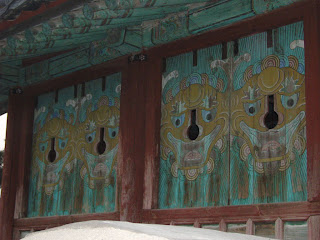
The bell-house's ceiling decorations.




"Harmonious City, Happy Suwon."
Happy Suwon is the citie's motto. It stands for something:
H: Harmonious - Harmonious City, Happy Suwon.
A: Abundant - Suwon, the city with abundant cultural and tourist resources.
P: Paramount - Suwon, the city of hi-tech industries.
P: Prosperous - Suwon, the city of a promise for a prosperous future.
Y: Young - Suwon, the young and dynamic city.
The tree of the city is the Pine tree.
The flower of the city is the Azalea.
The bird of the city is the White Heron.
The symbol mark of the city is unrenderable here.


A diagram of a cow, plus 3 police officers.

Eat it ALL!!!1

Laundry drying.

This is actually from a restaurant near our hakwon in Anyang, but I had to include it due to it's English-abuse:
"Welcomes to buljanggun you use directness roasts the truth charcoal it will be able to experience the premium barb ecued which is hot"
--This is exactly why we're here, people, if you ever doubt that your teaching job at a hakwon has purpose!

Another fellow from Bloomington, IN who is now visible in South Korea!

A couple of totem-pole looking fellows near the Suwon Tourist Information Center.

An old wooden/metal gate to a private residence in Suwon.


I don't know who created this, or why. It was kind of disturbing.

There were prostitutes within 150 feet of this church.
Hwaseong Fortress: Built between the years 1794-1796, the Hwaseong Castle and surrounding wall encompassed the top of a mountain at the center of what is now the modern city of Suwon. It's wall ran about 5.75 kilometers and now surrounds a surprising part of the city itself.
"Welcomes to buljanggun you use directness roasts the truth charcoal it will be able to experience the premium barb ecued which is hot"
--This is exactly why we're here, people, if you ever doubt that your teaching job at a hakwon has purpose!

Another fellow from Bloomington, IN who is now visible in South Korea!

A couple of totem-pole looking fellows near the Suwon Tourist Information Center.

An old wooden/metal gate to a private residence in Suwon.

Nazis!
...er, Buddhists.

...er, Buddhists.


I don't know who created this, or why. It was kind of disturbing.

There were prostitutes within 150 feet of this church.
Hwaseong Fortress: Built between the years 1794-1796, the Hwaseong Castle and surrounding wall encompassed the top of a mountain at the center of what is now the modern city of Suwon. It's wall ran about 5.75 kilometers and now surrounds a surprising part of the city itself.

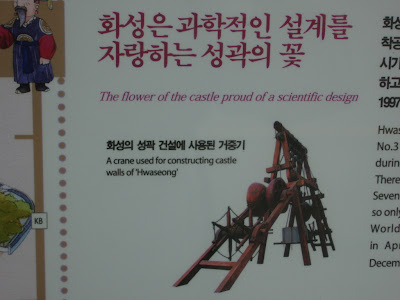
"The flower of the castle proud of a scientific design."

It's hard to provide perspective for how steep this was.


It's hard to provide perspective for how steep this was.


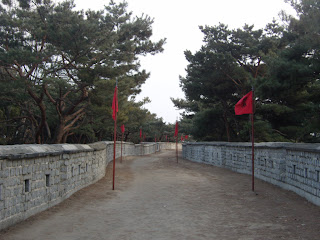
The South post, the first part of the castle wall we saw.


The ceiling decoration of a doorway.


Brian thinks it looks like a peasant revolt! This was on a statue that definately post-dated the origins of the castle itself.


A crossbow turret.


Brian stepping down from the crossbow turret.


There was a place on the mountain for exercise.

Working those abs!

A gi-normous bell.


What it means when you hit the bell with the log-like thing.

The log-like thing.


What it means when you hit the bell with the log-like thing.


The bell-house's ceiling decorations.


The North-gate defenses in the dark.
Suwon again.

"try to use your sense to make you look better"
They've always said that models and the fashion world make people feel insecure about their looks....well, now they also make you feel ugly AND stupid with a nice dose of verbal abuse!

Cotton candy for sale.

After the castle walk, Brian and I walked through the nightlife area a bit and found the "Very Good Man Coffee Shop."

I don't want to go to where they sell or serve beer, I want to go to where they "store" it. Heh. Does BMW know about this?

Suwon again.

"try to use your sense to make you look better"
They've always said that models and the fashion world make people feel insecure about their looks....well, now they also make you feel ugly AND stupid with a nice dose of verbal abuse!

Cotton candy for sale.

After the castle walk, Brian and I walked through the nightlife area a bit and found the "Very Good Man Coffee Shop."

I don't want to go to where they sell or serve beer, I want to go to where they "store" it. Heh. Does BMW know about this?

This bar's name sounds like the beginning of a letter from someone in Alcoholics Anonymous.
"Dear Bar,
You've ruined my life.
-Sincerely,
Steve."
"Dear Bar,
You've ruined my life.
-Sincerely,
Steve."
Subscribe to:
Posts (Atom)